The post AI Startup Perplexity Bids $34.5 Billion to Acquire Google Chrome appeared first on TheWrap.
]]>As first reported by The Wall Street Journal, several investors, including large venture capital funds, have stepped in to back Perplexity’s bid for Google Chrome, which has an estimated value of between $20 billion and $50 billion. Perplexity’s value is $16.5 billion shy of the money its offering to put up for Chrome.
Breaking down the formal terms of its official bid, Perplexity said it is committed to:
- Ongoing and substantial investment in Chromium, noting 3B over the next two years
- Never changing user defaults without giving users the choice
- Never stealthily replacing the default search engine of Chrome (Google)
- Making offers to a substantial portion of Chrome talent
- 100 months of availability and support for Chrome users
“For Perplexity, this is an important commitment to the open web, user choice and continuity for everyone who has chosen Chrome,” a spokesperson for Perplexity told TheWrap.

Perplexity’s bid is the latest in Google’s legal battle with the DOJ, which sued the tech giant in October 2020 over alleged antitrust violations, claiming it held a monopoly over fair competition in the search and advertising markets.
In November 2024, after finding that Google did in fact break antitrust laws in an effort to maintain a monopoly on web searches that same year, the DOJ pushed for a federal judge to dismantle Google to boost competition.
“The playing field is not level because of Google’s conduct, and Google’s quality reflects the ill-gotten gains of an advantage illegally acquired,” DOJ lawyers wrote in a filing with the U.S. District Court for the District of Columbia. “The remedy must close this gap and deprive Google of these advantages.”
The DOJ tasked Judge Amit Mehta, who sided with the department in August 2024, with prohibiting Google from making deals with Apple and Samsung. Google, the department claimed, pays Apple $20 billion per year to be the default search engine on iPhones.
In April 2025, a U.S. District Judge Leonie Brinkema found that Google again violated antitrust law by maintaining a monopoly over online advertising technology that “substantially harmed” its customers and stifled competition.
The DOJ, over the course of a three-week trial, has “proven that Google has willfully engaged in a series of anticompetitive acts to acquire and maintain monopoly power in the publisher ad server and ad exchange markets for open-web display advertising,” the ruling read.
Judge Mehta, according to WSJ, may decide this month on how competition should be restored, which could involve forcing Google to sell Chrome — and that’s where Perplexity comes in. The WSJ report said that Perplexity wrote a letter to Alphabet CEO Sundar Pichai with an offer to buy Chrome, framing the plan as one “designed to satisfy an antitrust remedy in highest public interest by placing Chrome with a capable, independent operator.”
The post AI Startup Perplexity Bids $34.5 Billion to Acquire Google Chrome appeared first on TheWrap.
]]>The post Jim Acosta’s Interview With AI Parkland Shooting Victim Torched as ‘Grotesque Puppet Show’ appeared first on TheWrap.
]]>On Monday, the former CNN White House correspondent posted an interview with an AI avatar of Joaquin Oliver – a victim of the 2018 school shooting in Parkland. Although the avatar was created by Oliver’s parents, and the interview was conducted to have a discussion on gun control, Acosta was quickly slammed online for agreeing to the conversation.
“You don’t have an interview. You’re facilitating a grotesque puppet show, using grieving parent’s heartbreak for a bit,” one Bluesky user wrote. “The bar is in hell and you still managed to trip on it.”
You don't have an interview. You're facilitating a grotesque puppet show, using grieving parent's heartbreak for a bit. The bar is in hell and you still managed to trip on it.
— OYL – Obstreperous Young Leather (@oyleather.bsky.social) August 4, 2025 at 5:47 PM
The conversation occurred on what would have been Oliver’s 25th birthday and was organized through his parents’ gun control group Change the Ref, but that did not stop social media critics from being disgusted by the fact the conversation happened at all. Some even brought up whether the interview was journalistically ethical. Watch the interview here.
“I was taken from this world too soon due to gun violence while at school,” the AI Oliver said. “It’s important to talk about these issues so we can create a safer future for everyone.”
Another Bluesky user reacted: “You’re interviewing an AI recreation of a person who was murdered by a spree killer? Wow. It’s hard to accept that no one around you suggested that this was probably in the worst possible taste.”
You’re interviewing an AI recreation of a person who was murdered by a spree killer? Wow. It’s hard to accept that no one around you suggested that this was probably in the worst possible taste. AI exists, we know that, but just because you CAN do something with it, that doesn’t mean you SHOULD.
— Fi 🏴 I STAND WITH PALESTINE & UKRAINE 🇵🇸 🇺🇦 (@asenathmagic.bsky.social) August 5, 2025 at 1:34 AM
“‘I’ll have a one of a kind interview with Joaquin Oliver’ no you won’t you’re talking to a glorified answering machine message you dingbat,” another user wrote.
"I’ll have a one of a kind interview with Joaquin Oliver" no you won't you're talking to a glorified answering machine message you dingbat
— Former bulletin board power user (@thatguywasfly.bsky.social) August 4, 2025 at 12:19 PM
Acosta asked the AI personal questions about favorite movies and sports teams but also asked how it would work to find a solution to gun control.
“I believe in a mix of stronger gun control laws, mental health support and community engagement,” it said. “We need to create safe spaces for conversations and connections, making sure everyone feels seen and heard. It’s about building a culture of kindness and understanding.”
The AI added: “Though my life was cut short, I want to keep inspiring others to connect and advocate for change.”
Watch the full interview between Acosta and the AI above.
The post Jim Acosta’s Interview With AI Parkland Shooting Victim Torched as ‘Grotesque Puppet Show’ appeared first on TheWrap.
]]>The post New York Times Seals $20 Million AI Deal With Amazon | Report appeared first on TheWrap.
]]>The multiyear deal was announced in May, but the financial terms of the deal were first reported by The Wall Street Journal on Wednesday.
Beyond NYT news stories, Amazon will also be able to share content from NYT Cooking and The Athletic, its subscription sports outlet. The Amazon deal stands out, considering The Times is currently suing OpenAI, the parent company of ChatGPT; The Times claims OpenAI illegally used its content without consent.
As WSJ noted, this is the first content licensing deal The Times has signed related to AI, and similarly, this is the first content licensing deal Amazon has signed with a publisher related to its AI products.
The new pact adds to a growing list of agreements between media outlets and AI companies. News Corp., Vox Media, Business Insider and Axel Springer, among other outlets, have content-sharing deals with OpenAI, while Fortune and Time have deals with Perplexity AI.
In related Amazon-AI news, the tech giant invested in Fable Studio, the company behind the Showrunner platform that creates TV shows using AI, on Wednesday. You can read more about Showrunner by clicking here.
The post New York Times Seals $20 Million AI Deal With Amazon | Report appeared first on TheWrap.
]]>The post Amazon Invests in Fable, Company Behind ‘Netflix of AI’ Streaming Platform appeared first on TheWrap.
]]>Fable CEO Edward Saatchi has called Showrunner the “Netflix of AI,” believing it will be the next hub for not only creators but also for fans to come and watch their go-to programs. Amazon’s undisclosed stake in Fable comes on the same day the company is releasing Showrunner widely to the public, after it had been available on an early access basis.
If Showrunner sounds familiar already, that is because the platform created an AI-version of “South Park” in 2022 (Paramount, as well as show creators Trey Parker and Matt Stone, did not participate). The AI “South Park” episodes Showrunner created have since been viewed more than 80 million times, the company said on Wednesday.
Showrunner allows users to create scenes and full episodes of series by typing in a few words about what they want to see; the platform then creates the voices, dialogue and different shots in the scenes, and is able to develop storylines; Showrunner also keeps characters consistent between scenes and episodes, which can run up to 22 minutes long.
Fable is hoping it has its first hit AI-powered TV show ready to go, with the company on Wednesday debuting “Exit Valley,” which Saatchi told TheWrap is a “Family Guy”-style satirical comedy that pokes fun at tech execs like Elon Musk and Sam Altman who live in “Sim Francisco.”

Something else that stands out: “Exit Valley” is a “playable” show where people can add themselves to scenes or make new scenes and episodes based on what they tell Showrunner. Looking ahead, allowing users to tweak their favorite shows is something that will benefit both the rights holders and the fans, Saatchi told TheWrap.
“The terms of service will be very clear: the model provider owns everything that’s generated with the model, because it’s in the story world that they own,” Saatchi said.
He continued: “It’s just money that’s being left on the table, and it’s also an artistic opportunity that’s being left on the table. Meaning, designing a two-hour film is obviously one incredible artistic charge; designing an infinite story world with near-infinite planets and characters and all of that, where you come by and engage with it, that’s a whole other creative challenge.”
Saatchi said Fable is aiming for a licensing deal with a “major streamer” by the end of 2025. He added that Fable will use the new funding to hire more workers, including new staffers from Google’s DeepMind AI division; the San Francisco-based company will also be expanding its team in Los Angeles, where some Fable employees are already based, as it continues to talk to studios.
Wednesday’s announcement comes at a time when the relationship between Hollywood and AI is lukewarm, at best. But there have been signs that studios are warming up to using it, with Netflix on its recent earnings call saying it used the technology to create some visual effects.
Saatchi, in a recent conversation with TheWrap, said he believes AI and playable content is the next step in the evolution of shows and movies — akin to the move from DVDs to streaming. But more than that, he said it offers a new way for Hollywood content to remain culturally significant.
“This might change the relationship between the audience and filmmaker in a way that could be very important, in an era when gaming and social media are quite competitive with film. I want cinema to be the dominant art form for the next 50 years,” he insisted. “And right now, it looks like gaming is on the path to being the dominant arm form. So let’s fight back.”
The post Amazon Invests in Fable, Company Behind ‘Netflix of AI’ Streaming Platform appeared first on TheWrap.
]]>The post Could AI Kill Off Hollywood’s Talent Pipeline? appeared first on TheWrap.
]]>He got his start, like many executives in Hollywood, reviewing scripts and passing them to higher-level decision makers, according to Robichaux, who declined to name the person. But as the presence of artificial intelligence expands throughout the industry, low-level jobs like a script reader will be among the first to disappear.
“Would his job even exist if they didn’t need assistants reading all the screenplays coming over the transom?” Robichaux said in an AI roundtable hosted by WrapPRO last week. “If his job doesn’t exist, does he not become a producer and does ‘The Brutalist’ not get made?
“Worst of all, would I have a career?”
The hypothetical question posed by Robichaux, who has written episodes of “Brooklyn Nine-Nine” and is writing the “Wedding Crashers” sequel, has a firm basis in reality, with AI promising to handle a lot of the lower-level grunt work for everyone. It’s happening faster than you think, with Anthropic CEO Dario Amodei telling Axios that he expects the technology to wipe out half of all entry-level white collar jobs over the next one to five years (although he wouldn’t be the first tech executive to make overly aggressive predictions).

But what’s less discussed is the consequence of losing some or even all of those entry-level jobs, whose real value lies in bringing in young talent and educating them about the business from the ground up. That kind of institutional knowledge is invaluable in a field as complicated and politically fraught as entertainment, and the industry risks losing what is essentially a training ground for the next-generation of decision makers.
“It does create a pipeline problem,” Robichaux said. “Every single major Hollywood producer started with a low-level industry job that is going away.”
What is lost
In India, thousands of people grow up aspiring to work for consumer goods giant Unilever. Once hired, the company sends that new hire to a rural community to sell soap, according to Arun Chandrasekaran, an analyst at research firm Gartner. That’s because the company wants the employee to understand how consumers buy their products and how price sensitivity actually works in the real world.
It’s a practical example of the kind of institutional knowledge a person gains when doing entry-level work as they work their way up the ranks of their field, and isn’t different from the kind of skills, hacks and short-hand communication you pick up on the set of a film or show.
But what happens to that experience when AI starts to replace these positions? There’s the risk that short-term gain in reduced costs may come at the expense of talent with the necessary critical thinking skills to lead down the line.
“We would lose some of that lower-level tacit knowledge, which is important for higher-level decisions,” Chandrasekaran said.
Talent agencies, for instance, start trainees in the mailroom, having them progress as assistants handling administrative tasks before eventually getting the chance to become an agent. Likewise, script readers and assistants get a chance to absorb nuances of the entertainment business, learning what works and what doesn’t work with audiences as they end up being the producers or writers of the next generation. Losing those positions means one of the more realistic entrances into entertainment is shut off.
Getting into Hollywood is already difficult, oftentimes reliant more on who you know vs. what you can do. With fewer opportunities up for grabs, it could just get worse.
“AI could accelerate the existing dynamics,” said Brian Justie, a senior research analyst at the UCLA Labor Center.
It’s already happening in tech
Hollywood has been relatively conservative when it comes to adopting AI, so you can look to the more aggressive tech industry as a bellwether for the impact of the technology.
It’s nothing short of brutal.
The total tally of layoffs in the tech industry has exceeded 100,000 this year, according to a count conducted by The Bridge Chronicle. That’s been led by big cuts from Microsoft, Meta, Intel and others.
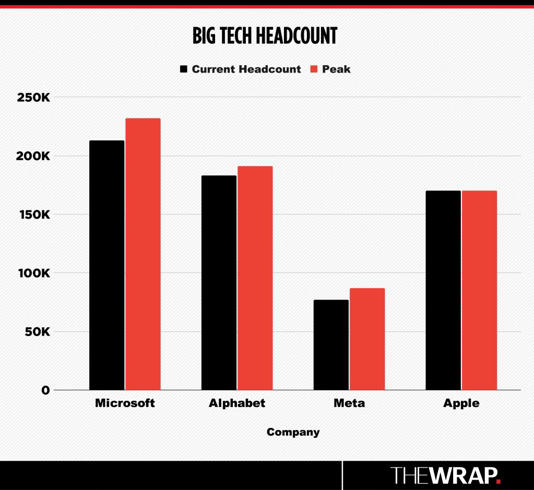
Microsoft CEO Satya Nadella in April said up to 30% of his company’s code is now written by AI; over the next three months, his company laid off 15,000 employees. Google was willing to spend $2.4 billion to hire a CEO and a few engineers because their AI expertise was specifically focused on programming to replace coders.
Last month, Amazon CEO Andy Jassy told employees, “In the next few years, we expect that this will reduce our total corporate workforce as we get efficiency gains from using AI extensively across the company.”
While the entertainment industry may not follow tech’s playbook to a tee, it’s not a stretch to see the allure of cutting costs inspiring similar moves. Advancements in AI capabilities around VFX could potentially see layoffs in that area alone.
Entry-level 2.0?
Not everyone thinks the end of grunt work for a new hire spells doom for the industry. Scott Mann, founder and co-CEO of Flawless AI, a post-production visual effects company, said AI could potentially change what an entry-level position looks like.
Traditionally, it’s incredibly difficult to jump into a position where you’re directing or writing a film. But AI tools will eventually make it easier to craft films from the get go, said Mann, who was also on the WrapPRO AI roundtable. You’re already seeing it with creators, with tools provided by the likes of YouTube and TikTok enabling more polished videos.

“It’s scary because it’s not what we know,” he said. “But it changes what ‘entry-level’ could look like.”
Hannah Elsakr, vice president of global GenAI new business ventures at Adobe, echoed the sentiment, noting that new hires may enter at a different level without the grunt work. She added that it’s happening with coders, and that the more sophisticated work required, whether it’s creative or coding, may help companies identify the “real gems” earlier, allowing them to advance faster.
It’s also unclear if AI will actually replace all of these tasks. While the technology has made huge leaps over the last three years, there remain limitations, particularly on the creative side. Justie warned that AI won’t have the same impact across all jobs.
It’s clear there’s a shift happening with increasing comfort in relying on AI and bots to handle tasks for us. But what happens if that institutional knowledge built up over experience and grunt work goes away?
“The risk is we become so dependent on AI, when we have a catastrophic element that AI doesn’t foresee, we can’t make decisions,” Chandrasekaran said.
And if Hollywood is anything, it’s unpredictable and, at times, even catastrophic.
The post Could AI Kill Off Hollywood’s Talent Pipeline? appeared first on TheWrap.
]]>The post Trump Says It Is ‘Not Do-able’ for AI Companies to Pay for All Copyrighted Content Used in Training Models appeared first on TheWrap.
]]>While speaking at the AI Summit on Wednesday, Trump explained that the United States needs to stay competitive with countries like China when it comes to AI. Part of that means not expecting companies to pay for using copyrighted material used in training.
“You can’t be expected to have a successful AI program when every single article, book or whatever you’ve studied, you’re expected to pay for,” the president said. “We appreciate that, but you just can’t do that because it’s not do-able. And if you’re going to try and do that, you’re not going to have a successful program.”
Trump continued: “When a person reads a book or an article, you’ve gained great knowledge. That does not mean that you’re violating copyright laws or have to make deals with every content provider. You just can’t do it. China’s not doing it.”
The president spoke as the White House rolled out its AI Action Plan. Much of the current administration’s planning deals with expanding data centers and lowering regulations for tech companies and AI – a stark opposite from the Biden administration’s commitment to investigating the safety and regulation of the growing industry. The comments likely come as a relief to many companies working in the AI space that have long-argued that such materials fall under fair use law.
“When you have something, and when you read something, and when it goes into this vast intelligence machine, we’ll call it, you cannot expect to every time, every single time, say, ‘Let’s pay this one that much,’” Trump added. “It just doesn’t work that way. Of course, you can’t copy or plagiarize an article, but if you read an article and learn from it, we have to allow AI to use that pool of knowledge without going through the complexity of contract negotiations.”
Watch the full clip of Trump’s speech, above.
The post Trump Says It Is ‘Not Do-able’ for AI Companies to Pay for All Copyrighted Content Used in Training Models appeared first on TheWrap.
]]>The post AI in Hollywood: How It Can Democratize Filmmaking — and Remain Ethical | Exclusive Video appeared first on TheWrap.
]]>“AI tooling that does that is really a silver bullet for Hollywood…It’s ultimately going to create more jobs if the industry is thriving,” said Scott Mann, founder and co-CEO of Flawless AI, who explained that the technology could be used to lower production costs and enable bets on more a wider range of projects.
That’s one of the key takeaways from a WrapPRO roundtable discussion on AI, where Mann was joined by four other experts: Richard Kerris, Nvidia’s vice president and GM of media and entertainment; Sarah Charlton, chief business officer of AI video production company Moonvalley; Hannah Elsakr, Adobe’s vice president new GenAI business ventures, and Van Robichaux, a writer and producer for “Brooklyn Nine-Nine” who is now writing the sequel to “Wedding Crashers.”
The roundtable comes at a pivotal time, with talk of AI just about everywhere and the pressure to embrace the technology only increasing. The technology has been in the sights of Hollywood, with the issue being a sticking point in the last negotiations between the various unions and the studios.
The topics ranged from the responsible use of copyrighted material to train AI models to the question about what the technology will do to AI.
The participants, who spoke to Roger Cheng, TheWrap’s managing editor for business and PRO, were bullish on AI’s potential for filmmakers. But they all understood the importance of employing the technology the right way to unlock its potential.
“We’re incredibly excited about it, because it does help democratize what has traditionally been a very difficult and costly environment to create the kind of visuals that people want to use to tell great stories,” Kerris said.

It can do so by offering relatively cheap tools to upstart filmmakers, he added. Those tools can then be used to bring stories to life that otherwise would not have been made only a few years ago.
Seeing AI as a “tool” to boost creativity, rather than curtail original ideas or cut jobs, was a view several of the panelists took.
Elsakr echoed Kerris, likening AI to “just another paintbrush in the toolkit of artistry.” And Mann, the co-founder of Flawless AI, a company that specializes in generative AI tools for filmmakers, said he is focused on making “tools for artists that help artists.”
Analyzing the impact
At the same time, the potential for AI to help on the production side has raised concerns it could decimate large swaths of the entertainment industry. Just this week, Bloomberg reported Netflix used Runway AI’s video software for production work, and more filmmakers are feeling comfortable discussing how they are using AI.
In May, Brian Grazer said he is “excited” by AI and that Imagine Entertainment has used AI on post-production work, including for its recent “Churchill at War” Netflix documentary; at the same time, Grazer said he does not believe AI will replace human writers anytime soon.
Robichaux said the “big concern” in Hollywood right now is whether AI will kill jobs. He told Cheng that, while he feels those concerns are “warranted,” he is optimistic AI can spur more storytelling — which will ultimately lead to more production and jobs.
“If you look at how the output of Hollywood has reduced in the last two years, what you can see is that what will bring more jobs is more production,” Robichaux said.
He continued: “And I do think that bringing down some of these [production] costs [with AI], while it might seem we’re employing fewer people — and that might be true on a project by project basis — but if it increases the number of projects being made, I think that can actually lead to an increase [in entertainment jobs].”
Ethics in AI
How to use AI in an ethical way is a key issue in the media and entertainment worlds currently. And it was inevitably brought up during this roundtable discussion as well, with the word “ethical” being used two dozen times.
Both Robichaux and Mann noted there is a “trust” issue right now among creators and AI companies, where creators are worried their work is being used to train models without consent or compensation.
This looks like it could become an even bigger sticking point moving forward after AI companies like Anthropic and OpenAI were given the green light to train their models on copyrighted work, as long as they pay for it. The ruling gave a lot of wiggle room for how that can be done; rather than striking an expensive licensing deal with The New York Times, for example, AI companies can pay $2.50 for a copy of the Times and legally upload it to their database, according to the ruling from a California federal judge.
On Wednesday, President Donald Trump even said that AI companies shouldn’t be expected to pay for all of that copyrighted content.
“You can’t be expected to have a successful AI program when every single article, book or whatever you’ve studied, you’re expected to pay for,” the president said.
Moonvalley’s Charlton said her company is trying to find a middle ground that works for all sides. She added her company is aiming build a “commercially safe” option that will “empower [filmmakers’] storytelling, without needing to make compromises on the underlying data sets or the creative choices that are being made.”
Elsakr, similarly, noted it is still the “early innings” of AI and the rules are still being written around how it can be used. But she said Adobe, whose customers now generate over 1 billion assets each month using its Firefly generative AI models, wants to make sure “human ingenuity” remains the “center of the craft.”
How the majority of AI companies and studios move forward, though, will be sorted out as more copyright cases make their way through court. And this issue remains front of mind for creators like Aubrey Plaza and Joseph Gordon-Levitt, who said earlier this year they are worried writers and copyright holders are not being compensated fairly for having their work used to train AI models.
Looking ahead, Mann said he remains optimistic that AI, rather than leading to a net drop in jobs, will spur a new era of moviemaking that will ultimately be good for Hollywood.
“The key to have a growing and thriving industry — which, right now, it isn’t. Right now, we don’t have that. We only have movies with massive budgets getting made, and very little risks and originality,” Mann said. “[The key is] bringing the cost and time it takes to make productions [down], which opens up for more originality [and] allows you to do more with less.”
You can watch the video of WrapPRO’s full panel conversation above.
Join top tech leaders from Fox, Paramount and USC as they break down how AI is moving from concept to production — and what that means for the future of storytelling. Don’t miss “From Ideation to Innovation: AI in the Studio Pipeline” at TheGrill 2025.
September 30 · DGA Theater, Los Angeles
The post AI in Hollywood: How It Can Democratize Filmmaking — and Remain Ethical | Exclusive Video appeared first on TheWrap.
]]>The post Google’s AI Summaries Have Chopped Article Clicks Down by Half appeared first on TheWrap.
]]>The survey found American users were nearly half as likely (46.7%) to click on a search link after reading an AI summary provided by Google atop the page. Here is the key section of Pew’s survey, which was based on 900 respondents and released on Tuesday:
“Users who encountered an AI summary clicked on a traditional search result link in 8% of all visits. Those who did not encounter an AI summary clicked on a search result nearly twice as often (15% of visits),” Pew wrote.
Pew continued: “Google users who encountered an AI summary also rarely clicked on a link in the summary itself. This occurred in just 1% of all visits to pages with such a summary.”
The survey recap was written by Pew data scientist Athena Chapekis and Anna Lieb, a computational social science assistant.
Google introduced AI summaries atop some its search results last year, and Pew found 18% of the 68,879 searches its respondents made included an AI recap. The survey also found “users are more likely to end their browsing session entirely after visiting a search page with an AI summary”; 26% of pages with an AI summary were closed out instantly, compared to 16% of pages that did not have recaps.
Pew’s survey comes as concerns over how AI is eating into web traffic have grown in the media world — and other industries as well. Apple VP Eddy Cue recently noted Safari searches dipped for the first time in two decades, likely due to the rise of AI; Google pushed back on that claim, and the company reported its “Search and Other” business grew 10% year-over-year to $50.7 billion in Q1.
Google has an opportunity to talk about — and be asked by analysts about — AI’s affect on search on Wednesday afternoon, when it reports its second quarter earnings. Check TheWrap after the closing bell for a look at Google’s Q2 performance.
The post Google’s AI Summaries Have Chopped Article Clicks Down by Half appeared first on TheWrap.
]]>The post Trump White House Launches AI Website, Shares Plan for ‘Global Dominance’ appeared first on TheWrap.
]]>That plan, according to the site, includes “removing red tape and onerous regulation” on American AI companies, growing the electric grid, and promoting the ethical use of AI both domestically and globally. Foreign adversaries like China must also be blocked from “free-riding on our innovation and investment,” the new site said.
“Winning this race will usher in a new era of human flourishing, economic competitiveness, and national security for the American people,” the website added.
The website’s launch comes after President Trump and Vice President JD Vance have made AI a key focus since they entered the White House in January.
Trump, right after being inaugurated, tapped OpenAI, Oracle, and SoftBank to lead his “Stargate” AI infrastructure project; the three companies committed to spending up to $500 billion to building America’s AI framework, but the Wall Street Journal reported this week the plan has “struggled to get off the ground.”
Trump has previously said it is important for the U.S. to stay ahead of other countries — and in particular, China — when it comes to AI innovation.
“AI is the new oil; it’s the oil of the future,” Trump said during a 2023 speech. “We have to make sure we dominate it.”
He has also expressed some concerns over AI being a “superpower,” which he told Logan Paul during a podcast interview last year. Trump added he found AI’s potential a bit “alarming.”
The new AI.gov website includes a section on an upcoming “Presidential AI Challenge” that aims to “foster interest and expertise in AI technology in America’s youth.” Early training and exposure to AI will “demystify this technology and prepare America’s students to be confident participants in the AI-assisted workforce, propelling our Nation to new heights of scientific innovation and economic achievement,” the website claimed. It said more info on registering for the Presidential AI Challenge is coming soon.
The new site went live a few hours before Trump is expected to sign executive orders tied to AI. “One order will target political bias in A.I. chatbots, and another will encourage the export of A.I. hardware and software,” The New York Times reported.
The post Trump White House Launches AI Website, Shares Plan for ‘Global Dominance’ appeared first on TheWrap.
]]>The post New Congressional Bill Bans AI Companies From Training on Copyrighted Works or Personal Data Without Consent appeared first on TheWrap.
]]>The AI Accountability and Personal Data Protection Act would give both individuals and companies a path to sue for use of their personal data or copyrighted works without prior consent.
“AI companies are robbing the American people blind while leaving artists, writers and other creators with zero recourse,” Hawley said in a statement. “It’s time for Congress to give the American worker their day in court to protect their personal data and creative works.”
The bill also prohibits use of data if consent was “obtained through coercion or deception; or as a condition of using a product or service through which the … covered data exceeds what is reasonably necessary to provide that product or service.”
Blumenthal added: “Tech companies must be held accountable – and liable legally – when they breach consumer privacy, collecting, monetizing or sharing personal information without express consent. Consumers must be given rights and remedies – and legal tools to make them real – not relying on government enforcement alone.”
The issue is at a crossroads, as several large publishers have made licensing deals with companies like OpenAI to train large-language models on their copyrighted material. Meanwhile the ChatGPT parent has argued fair use in other cases that are still in litigation.
Hawley’s proposed legislation aims to counter a court ruling last month that gave AI companies a key legal victory, allowing companies to train their models on copyrighted work without the consent of creators or rights holders — as long as those works were obtained legally.
The ruling granted a lot of wiggle room in how AI companies go about legally obtaining copyrighted material, too. Rather than striking expensive licensing deals with publishers, AI companies can spend $2.50 on an issue of The New York Times and upload it to their training database, for example.
To read more about how Hollywood creators like Aubrey Plaza, Ben Stiller, and Joseph Gordon-Levitt are pushing back on AI companies using copyrighted work without paying those who created it, click here.
The post New Congressional Bill Bans AI Companies From Training on Copyrighted Works or Personal Data Without Consent appeared first on TheWrap.
]]>